Home Renovation Tools
Tools for Laying Laminate and Click Vinyl Flooring
What you need to install laminate and click LVT flooring: tapping block, pull bar, spacers, saws, underlay tools, and how to measure, cut and lay a floating floor.
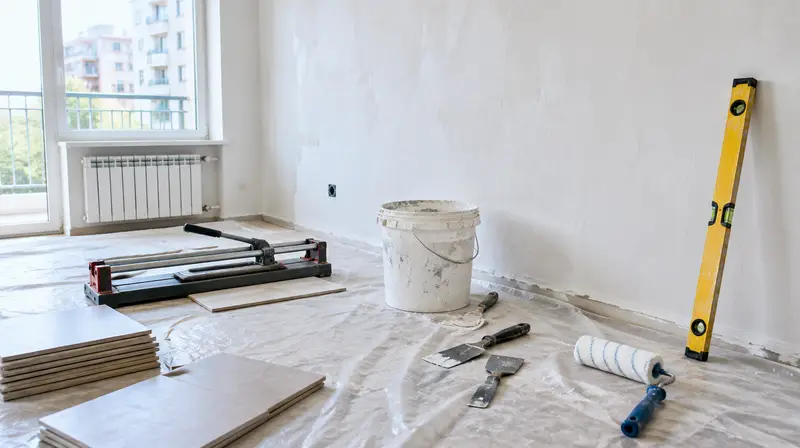
Click-together laminate and luxury vinyl plank (LVT/SPC) are among the most DIY-friendly floors. There is no glue, no nails, and the right tool kit is small and inexpensive. The secret to a professional result lies in preparation, correct expansion gaps and clean cuts.
Flooring kit
- Installation kit: tapping block, pull bar, spacers
- Saw: jigsaw or mitre saw (laminate); utility knife works for many rigid vinyl planks
- Multi-tool for undercutting door frames
- Tape measure, square, pencil, level or straightedge
- Rubber mallet, knee pads, utility knife, tape for underlay
Tool by tool
| Tool | Purpose | Tip |
|---|---|---|
| Tapping block | Knocks planks together on the long side without damaging the click profile | Never hit the plank directly with a hammer |
| Pull bar | Pulls the last plank in a row tight against the wall | Tap its end with a mallet |
| Spacers / wedges | Maintain the expansion gap at walls | Typically 8–12 mm for laminate; follow instructions |
| Rubber mallet | Used with the block and pull bar | White rubber avoids marks |
| Jigsaw with down-cut blade | Cuts, notches, curves | See jigsaw guide |
| Mitre saw or laminate cutter | Fast, square cross-cuts | Laminate guillotine cutters are quiet and dust-free |
| Utility knife + square | Score-and-snap cuts for rigid vinyl; trimming underlay | Several blades |
| Oscillating multi-tool | Undercut door frames and architraves | See multi-tool guide |
| Drill + spade bit / hole saw | Holes for radiator pipes | Hole 15–20 mm bigger than pipe for expansion |
| Straightedge / long level | Checking floor flatness | Typical tolerance is a few mm over 1–2 m; check the product |
Preparation
- Acclimatise packs in the room for 24–48 hours (or as instructed).
- Check flatness: fill dips and grind or sand high spots. Uneven subfloors cause joints to open or click.
- Moisture: on concrete, use a vapour barrier (damp-proof membrane) unless the underlay has one built in.
- Underlay: choose for acoustic insulation and compatibility with underfloor heating if present. Some vinyl planks have integrated underlay.
- Remove skirting boards or plan to use a scotia/quarter-round trim to cover the gap.
How to measure and plan
- Measure the room area and add 5–10% for waste (more for diagonal layouts). A laser distance meter makes this quick.
- Lay planks parallel to the longest wall or the main light source.
- Calculate the width of the last row. If it would be narrower than about 5 cm, trim the first row so both first and last rows are similar.
- Stagger end joints by at least 30–40 cm (follow the manufacturer's minimum).
How to lay a floating floor
- Undercut door frames with a multi-tool, using a plank on the underlay as a height guide.
- Lay underlay, taping seams without overlapping.
- Start in a corner with the groove side facing the wall (per instructions), with spacers along the walls.
- Click the short ends together, then angle and drop each new plank into the long side of the previous row, tapping with the block.
- Use the offcut from the end of each row to start the next row, if it is long enough.
- For the last row, measure and rip planks to width, remembering the expansion gap. Use the pull bar to close joints.
- Remove spacers, fit skirting or trim (nailed to the wall, not the floor) and transition profiles at doorways.
Never fix a floating floor to the subfloor, and never trap it under kitchen cabinets or heavy built-ins. It must be able to expand and contract.
Frequently asked questions
Can I cut laminate without a saw?
Laminate needs a saw or a dedicated laminate cutter. Many rigid vinyl (SPC) planks can be scored with a knife and snapped.
What expansion gap do I need?
Usually 8–12 mm for laminate and smaller for some vinyl products. Always follow the flooring manufacturer's instructions.
This guide is general information, not professional advice. Always read your tool's manual, use the right protective equipment and follow local building and electrical codes. See our disclaimer.