Power Tools Explained
Laser Levels and Laser Distance Meters Explained
How cross-line, rotary and point lasers work, green vs red beams, accuracy and self-levelling, plus how laser distance meters calculate areas and volumes.
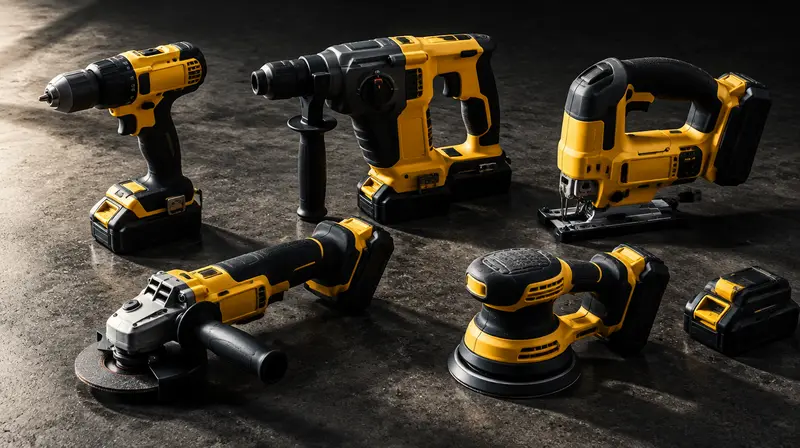
A laser level projects perfectly level and plumb lines across a room, so you can hang a row of pictures, set kitchen cabinets, align tiles or install a ceiling without marking with a spirit level again and again. A laser distance meter measures a room in seconds and calculates areas for flooring and paint. Both have become affordable and are genuinely useful for renovation.
Quick answer
- Cross-line laser with self-levelling: the best first laser for home renovation.
- Green beams are about 4× more visible to the eye than red; worth it for bright rooms.
- Look for accuracy of ±0.3 mm/m or better and a lock (pendulum) mode for angled lines.
- A laser distance meter (30–50 m range) makes measuring for flooring, paint and furniture fast and accurate.
Types of laser level
Cross-line laser
Projects one horizontal and one vertical line that cross. Ideal for pictures, shelves, tiles, cabinets and outlets. Many models project 360° lines around the room.
Multi-line / 3-plane laser (3×360°)
Projects one horizontal and two vertical 360° lines, giving level and plumb references on every wall, floor and ceiling. Great for partition walls, suspended ceilings and complete kitchens.
Point (dot) laser
Projects plumb, level and square dots. Used to transfer points from floor to ceiling (for example lights above a table or stud walls).
Rotary laser
A spinning beam creating a 360° plane over long distances, often used with a receiver outdoors for grading, fences and foundations. Overkill for most indoor DIY.
Key specifications
- Self-levelling: the pendulum settles the lines automatically when placed within a few degrees of level. The lines blink if the tool is outside its range.
- Pendulum lock: allows angled lines for staircases.
- Pulse mode: needed to use a receiver outdoors or in bright light.
- Batteries: some use tool platform batteries or USB-rechargeable packs.
- Mounting: tripod, wall clamp, magnetic bracket or a floor-to-ceiling pole.
How to use a cross-line laser
- Place the laser on a tripod or bracket at a convenient height.
- Unlock the pendulum and switch on. Wait for the lines to stabilise.
- Move the laser or adjust the tripod height to bring the horizontal line to your mark.
- Mark points along the line with a pencil or use it directly as a guide (tiles, cabinets).
- Lock the pendulum before moving the laser to protect the mechanism.
Set the laser between two walls about 5 m apart and mark where the horizontal line crosses on both walls. Turn the laser 180° and mark again. The difference between the two marks on each wall should be the same; if the discrepancy is larger than the stated tolerance over that distance, the laser needs calibration.
Never look into the beam or point it at people. Most construction lasers are Class 2 or 3R; follow the warning label.
Laser distance meters
A laser distance meter (laser measure) measures distance to a wall by timing a reflected laser beam. Typical range is 30–100 m with accuracy around ±1.5–2 mm.
Useful functions
- Area and volume: measure length and width to get floor area for flooring or paint, height for volume.
- Continuous measurement: move until you reach a target distance.
- Pythagoras (indirect) measurement: estimate heights you cannot reach.
- Addition/subtraction and memory.
- Bluetooth app: add measurements to floor plans (on higher-end models).
Measure from the correct reference point (back of the device by default on most models). For flooring, add a waste allowance of 5–10% to the calculated area; see laminate flooring tools.
Frequently asked questions
Is a green laser worth the extra cost?
For indoor work in bright rooms or at longer distances, yes. Green lines are much easier to see. They use more battery power.
Can a laser level replace a spirit level?
For layout across a room, it is better. For checking a single shelf or door frame, a spirit level is still quicker. Most people use both.
This guide is general information, not professional advice. Always read your tool's manual, use the right protective equipment and follow local building and electrical codes. See our disclaimer.