Electronics & Appliance Repair
Anti-Static (ESD) Protection for Electronics Repair
What electrostatic discharge is, why it can damage electronics without you noticing, and how to set up a simple anti-static workspace with a mat, wrist strap and ESD-safe tools.
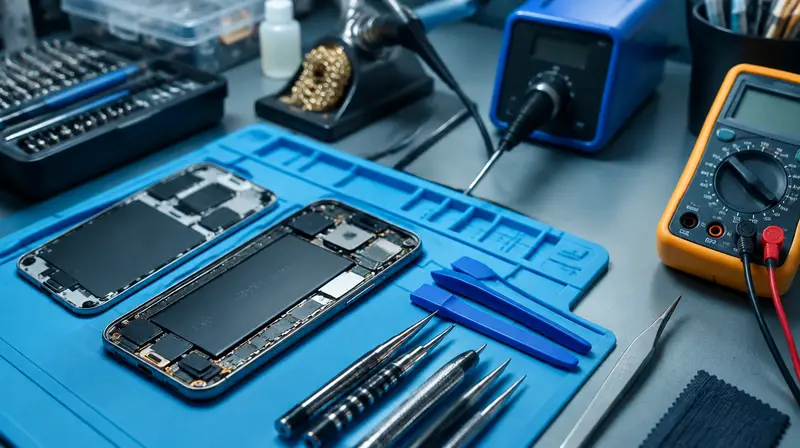
You have probably felt a static shock from a door handle. That spark can be thousands of volts. Most electrostatic discharges (ESD) are too small to feel, yet they can damage or weaken sensitive chips such as memory, processors and sensors. Anti-static precautions are cheap and simple, and they are good practice whenever you open electronics.
Quick answer
- Use an ESD wrist strap connected to a proper ground point or ESD mat.
- Work on an anti-static mat, not carpet.
- Store boards and parts in anti-static bags.
- Use ESD-safe tools (tweezers, spudgers, brushes).
- Avoid synthetic clothes and very dry rooms.
What is ESD and why does it matter?
When two materials rub together, electrons transfer and build up a static charge. Your body can easily carry several thousand volts when walking on carpet in dry air. When you touch a component, that charge discharges through it. Many chips can be damaged by discharges far below the threshold you can feel (roughly 3,000 V). Damage may be immediate (the device fails) or latent (it works now but fails weeks later).
What is sensitive?
- RAM, CPUs, GPUs, SSDs and motherboards
- Phone and tablet logic boards, cameras, sensors
- Bare circuit boards, microcontrollers (e.g. Arduino), MOSFETs
Assembled devices with their cases closed are well protected. The risk is when boards are exposed.
Setting up an anti-static workspace
| Item | Purpose | Note |
|---|---|---|
| ESD mat (dissipative) | Safe work surface that drains charge slowly | Connect to ground via its cord and resistor |
| Wrist strap | Keeps your body at the same potential as the mat | Includes a 1 MΩ safety resistor; wear it snug on skin |
| Ground connection | Common point for mat and strap | Use a proper ESD grounding plug or bonding point, not a random pipe |
| Anti-static bags | Storing and transporting parts | Shielding (metallic) bags offer the best protection |
| ESD-safe tools | Tweezers, spudgers, brushes | Made from dissipative materials |
| Humidity | Moist air reduces static build-up | 40–60% relative humidity is ideal |
Do not wear a grounded wrist strap while working on equipment connected to mains power or containing charged high-voltage capacitors. The strap is for unpowered electronics.
Simple habits without special equipment
- Touch a grounded metal object (such as the bare metal frame of a grounded, switched-off, plugged-in desktop PC case, where the plug and outlet are properly earthed) before handling parts, and do so again after moving around.
- Handle boards by the edges; avoid touching pins and contacts.
- Do not work on carpet; take off wool or synthetic outer layers.
- Keep plastic packaging, styrofoam and cling film away from the work area.
Frequently asked questions
Do I need an ESD mat to replace RAM or an SSD?
It is not essential if you ground yourself properly and handle parts carefully, but a wrist strap is inexpensive insurance.
Does a wrist strap make it safe to work on powered devices?
No. It is designed for ESD protection on unpowered electronics, not for shock protection.
This guide is general information, not professional advice. Always read your tool's manual, use the right protective equipment and follow local building and electrical codes. See our disclaimer.