Tool Safety
Personal Protective Equipment for DIY: Glasses, Ear Protection, Gloves and Masks
Which safety glasses, hearing protection, gloves and respirators you need for DIY and power tools, what the ratings mean, and when gloves are dangerous.
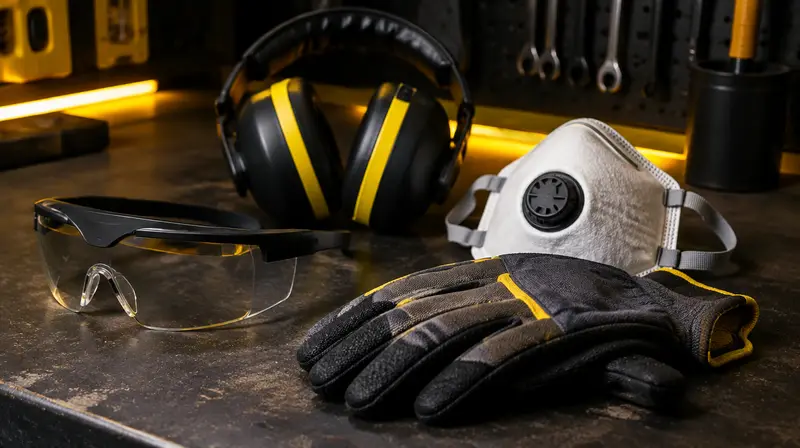
Protective equipment is the cheapest insurance you will ever buy. A pair of safety glasses costs less than a box of screws, yet eye injuries are among the most common DIY accidents. This guide explains what to buy, what the ratings mean and, importantly, when a piece of protective gear can make things worse.
Minimum kit for any DIYer
- Safety glasses rated ANSI Z87.1+ (US) or EN 166 (EU): wear them for every power tool job.
- Hearing protection: earmuffs or foam plugs for grinders, saws, rotary hammers and vacuums.
- Dust mask / respirator: at least N95 / FFP2 for sanding, cutting and drilling masonry.
- Work gloves for handling materials, but not when a glove could be caught by a spinning drill bit, lathe or bench grinder.
Eye protection
Drilling, cutting, grinding, hammering, chiselling and even pulling nails can send fragments flying at high speed. Normal prescription glasses are not safety glasses; their lenses and frames are not designed to stop impacts, and they leave the sides open.
What to look for
- Impact rating: ANSI Z87.1 with a "+" mark (high impact) in the US, EN 166 with an "F" or "B" mark in Europe.
- Side protection: wraparound lenses or side shields.
- Anti-fog coating: especially if you wear a mask, which pushes warm breath upwards.
- Over-glasses (OTG) models if you wear prescription glasses.
Goggles and face shields
Use sealed goggles for dusty overhead drilling, chemical splashes (strong cleaners, some adhesives) and fine dust. Use a face shield over safety glasses for angle grinders, wire wheels and anything that produces sparks or large fragments. A face shield alone is not enough protection.
Hearing protection
Hearing damage is gradual and permanent. Many power tools are loud enough to harm hearing with prolonged exposure. As a rough guide, anything above about 85 dB(A) for extended periods is harmful, and many angle grinders, circular saws, rotary hammers and shop vacuums exceed that.
| Tool | Typical sound level | Protection |
|---|---|---|
| Cordless drill-driver | ~70–85 dB(A) | Optional for short use |
| Impact driver | ~90–100 dB(A) | Recommended |
| Circular saw, jigsaw | ~95–105 dB(A) | Yes |
| Angle grinder | ~95–105 dB(A) | Yes |
| Rotary hammer | ~90–105 dB(A) | Yes |
Values are approximate; check the noise figure in your tool's manual. Look for the NRR (Noise Reduction Rating, US) or SNR (EU) on earmuffs and plugs. An NRR of 25–30 is typical for good earmuffs. Foam plugs work well only if rolled and inserted correctly.
Respiratory protection
Dust is the hidden hazard of renovation. Fine wood dust, plaster, and especially crystalline silica from cutting or drilling concrete, brick, stone and tiles can damage lungs. Older homes may also contain lead paint or asbestos.
- N95 / FFP2: minimum for sanding, cutting wood and drilling masonry.
- P100 / FFP3: better for silica dust, heavy sanding and long sessions. Reusable half-masks with P100/P3 filters are more comfortable and seal better than disposable masks.
- Organic vapour cartridges (A1/P3 or OV/P100): for solvent-based paints, varnishes and some adhesives.
- Fit matters more than the rating. Beards prevent a proper seal.
If your home was built before the 1980s (or before about 2000 in some countries), old floor tiles, textured ceilings, pipe lagging and paint may contain asbestos or lead. Do not sand, drill or break these materials until they have been tested. Asbestos removal usually requires licensed professionals.
Controlling dust at the source is even better than a mask: use tools with dust extraction connected to a shop vacuum with a suitable filter class, and wet-cut tiles and stone where possible.
Gloves: when to wear them and when not
Gloves protect against cuts, splinters, blisters and chemicals. But they can be dangerous around rotating machinery.
Wear gloves for
- Carrying timber, sheet material, tiles, metal
- Handling glass, sharp edges and blades
- Demolition and cleanup
- Chemicals, adhesives, grout (nitrile gloves)
- Angle grinding (snug-fitting leather gloves, recommended by most grinder manuals)
Do not wear loose gloves near
- Drill presses and a drill chuck close to your hand
- Bench grinders and wire wheels near the wheel
- Lathes
- Table saws where the hand is close to the blade
- Any tool where fabric could wrap around a spinning part
The rule: if a spinning part can grab the glove, the glove will pull your hand in. Always follow the tool manufacturer's instructions on gloves; some tools (such as angle grinders) recommend them, while others (such as drill presses) warn against loose gloves.
Glove types
- Nitrile-coated knit gloves: good all-rounders for grip and dexterity.
- Cut-resistant gloves (ANSI A2–A4 / EN 388 level B–D): for glass, sheet metal and blades.
- Leather gloves: for grinding, welding and rough work.
- Disposable nitrile: for chemicals, paint, oil and grout.
- Anti-vibration gloves: for long sessions with rotary hammers and breakers.
Other protective equipment
- Work boots with toe caps for demolition and heavy materials. At a minimum, closed shoes with firm soles.
- Knee pads for tiling, flooring and under-sink work.
- Hard hat / bump cap for demolition, attics and working under shelves or cars.
- Close-fitting clothing: roll up or fasten sleeves, remove jewellery and tie back long hair.
PPE by task
| Task | Eyes | Ears | Lungs | Hands |
|---|---|---|---|---|
| Drilling wood/plasterboard | Glasses | Optional | Optional | No gloves near chuck |
| Drilling concrete overhead | Goggles | Yes | FFP2/N95+ | Anti-vibration gloves optional |
| Angle grinding metal | Glasses + face shield | Yes | Optional | Leather gloves |
| Cutting tiles/stone dry | Goggles | Yes | FFP3/P100 | Work gloves |
| Sanding | Glasses | Recommended | FFP2/N95+ | Optional |
| Painting with solvents | Glasses | No | Organic vapour | Nitrile |
Frequently asked questions
Are regular glasses enough for drilling?
No. Regular glasses are not impact-rated and leave gaps at the sides. Use safety glasses rated ANSI Z87.1+ or EN 166, or over-glasses safety specs.
Should I wear gloves when using a drill?
Avoid loose gloves when your hand is close to the rotating chuck or bit. Snug-fitting gloves for holding the handle are usually fine, but follow your tool's manual.
Is a surgical or cloth mask enough for sanding?
No. Use a respirator rated at least N95 / FFP2, and preferably P100 / FFP3 for masonry and silica dust.
This guide is general information, not professional advice. Always read your tool's manual, use the right protective equipment and follow local building and electrical codes. See our disclaimer.