Beginners: Start Here
The Basic Home Tool Kit: What Every Apartment Needs
A practical checklist of the hand tools and power tools every home should have, what each one is for, what to spend and what to skip at first.
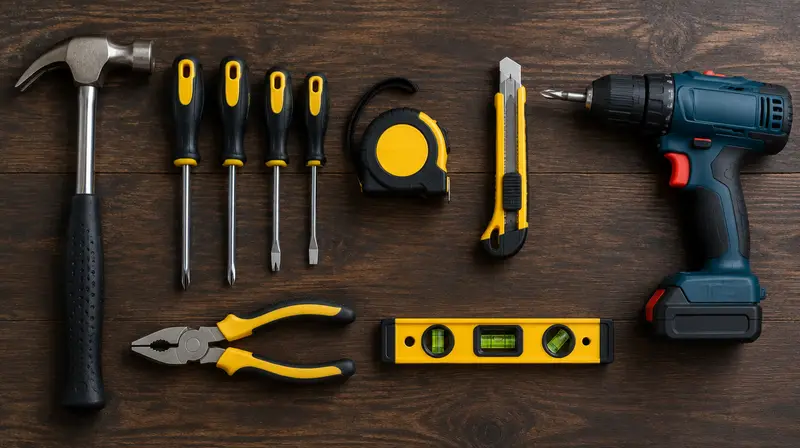
You do not need a garage full of equipment to handle most jobs around the home. About fifteen well-chosen tools will let you assemble furniture, hang pictures and shelves, tighten loose hinges, fix a dripping tap and deal with small emergencies. This guide lists exactly what to buy first, why each tool earns its place and roughly what it costs.
Quick answer
- Core hand tools: claw hammer, screwdriver set (or a multi-bit driver), tape measure, spirit level, utility knife, combination pliers, adjustable wrench, Allen (hex) keys.
- One power tool: an 18V/20V cordless drill-driver with two batteries. It will do more jobs than anything else you can buy.
- Consumables: a drill bit set, a screwdriver bit set, wall plugs (anchors), assorted screws, masking tape, a pencil.
- Safety: safety glasses and work gloves from day one.
- Budget: roughly $150 to $250 for a solid starter kit that will last years.
How to think about a starter kit
A good starter kit is built around the jobs you will actually do, not around a shiny 200-piece case. In an apartment or house, the most common tasks are:
- Assembling flat-pack furniture
- Hanging pictures, mirrors, shelves, curtain rods and TV mounts
- Tightening loose handles, hinges and screws
- Small plumbing jobs: a loose tap connection, a blocked trap, a new shower head
- Opening boxes, cutting cable ties, trimming carpet or sealant
- Measuring for furniture, blinds and appliances
Every tool below is chosen to cover several of these jobs. Buy decent quality for the tools you will use weekly (screwdrivers, tape measure, drill) and do not overspend on things you will use twice a year.
The essential hand tools
| Tool | What it is for | What to buy | Approx. price |
|---|---|---|---|
| Claw hammer | Nails, picture hooks, tapping things into place, pulling nails | 16 oz (450 g), fibreglass or steel handle with rubber grip | $15–25 |
| Screwdrivers | Furniture, switch plates, hinges, battery covers | Phillips PH1 and PH2, flat 3 mm and 6 mm, or a multi-bit driver with PH/PZ/flat/Torx bits | $15–30 |
| Tape measure | Everything | 5 m / 16 ft, 25 mm wide blade with a solid hook | $10–20 |
| Spirit level | Shelves, pictures, TV mounts, appliances | 60 cm / 24 in box level; a small torpedo level is a bonus | $12–25 |
| Utility knife | Opening boxes, cutting drywall, carpet, sealant | Retractable or snap-off with spare blades | $8–15 |
| Combination pliers | Gripping, bending, cutting wire | 180–200 mm, insulated handles | $10–20 |
| Adjustable wrench | Tap connections, nuts and bolts of any size | 200–250 mm (8–10 in) | $12–20 |
| Hex (Allen) keys | Flat-pack furniture, bikes, faucets | Metric set 1.5–10 mm (and SAE in the US) | $8–15 |
| Stud / wire detector | Finding studs, pipes and live cables before drilling | Basic stud finder with AC wire detection | $20–40 |
We explain each of these in more depth, including what makes a good one, in essential hand tools for home renovation.
The one power tool to buy first: a cordless drill-driver
If you buy only one power tool, make it a cordless drill-driver. It drills holes in wood, metal, plastic and (with the right bit and a hammer mode) brick. It drives screws far faster than a hand screwdriver, and with the clutch set correctly it will not strip or overtighten them.
For a first drill, look for:
- 18V (sold as 20V MAX in the US) platform, so you can add other tools later using the same batteries. Read why the battery platform matters before you buy.
- Two batteries of at least 2.0 Ah, so one charges while you use the other.
- A hammer (combi) function if you live in a concrete or brick building. For a lot of concrete drilling you will eventually want a rotary hammer, but a combi drill handles occasional holes for plugs.
- A brushless motor if the budget allows. It runs cooler and gets more work out of each charge.
Our full drill and drill-driver guide explains torque, clutch settings and chuck sizes in detail.
Skip the cheap 12V "screwdriver" drills with a single tiny battery if you live in a concrete building. They are fine for furniture but will struggle with masonry, and you will end up buying a second drill.
Bits, fixings and consumables
Tools are useless without the right accessories. Start with:
- Drill bit set with wood (brad point), metal (HSS) and masonry bits from 3 to 10 mm.
- Screwdriver bit set with PH1, PH2, PH3, PZ1, PZ2, flat, Torx T10–T30 and hex bits, plus a magnetic bit holder.
- Wall plugs (anchors) and screws: a mixed box of 6 mm and 8 mm plugs with matching screws covers most shelves. For plasterboard, buy a few proper hollow-wall anchors.
- Masking tape and a pencil for marking holes; tape also stops tiles and paint from chipping when drilling.
- Cable ties, electrical tape and a tube of all-purpose sealant.
Safety gear from day one
Buy safety glasses at the same time as your drill. Drilling overhead or into masonry throws dust and chips straight at your eyes. Add a pair of fitted work gloves for carrying and handling rough materials, and a few disposable FFP2/N95 masks for dusty jobs. Remember that gloves should not be worn when operating a drill with a rotating chuck close to your hand if they could catch; our safety section explains when.
Nice to have (buy when the need appears)
- Small handsaw for trimming wood and plastic.
- Water pump pliers for plumbing nuts and trap connections.
- Long-nose pliers and side cutters for small parts and wire.
- Stepladder: a three-step ladder is safer than a chair. See our ladder safety guide.
- Headlamp or work light for under sinks and inside cupboards.
- Plunger and sink auger for blockages.
- Precision screwdriver set for glasses, toys and electronics.
What to skip at first
Resist the urge to buy tools "just in case". Specialist tools such as a tile cutter, a mitre saw or a wallpaper steamer are much better rented or borrowed until you know you will use them often. Our guide on buying, renting or borrowing explains how to decide.
We also recommend caution with large all-in-one tool cases. They often include low-quality pliers and screwdrivers you will replace, plus sockets and odd tools you never use. Read are pre-made tool kits worth it? for a fair comparison.
Where to keep it
A small tool bag or a single sturdy box is enough. Keep screwdrivers, pliers and the tape measure on top where you can reach them, and store bits and fixings in a compartment organiser. If you have children, store blades and power tools locked or out of reach; see storing tools safely with kids.
Frequently asked questions
How much should I spend on a first tool kit?
Around $150 to $250 buys good hand tools and a reliable cordless drill with two batteries. Spending less is possible if you already own some tools, but very cheap screwdrivers and tape measures are a false economy.
Is a pre-made tool kit a good idea for a first home?
A compact 40–60 piece kit from a reputable brand can be good value if you own nothing at all. Avoid huge kits with hundreds of pieces; most of the count is small bits and sockets.
Do I need a hammer drill in an apartment?
If your walls are concrete or brick, yes, at least a combi drill with hammer mode. For regular concrete drilling, a rotary hammer is far more effective.
What is the most-used tool in a home kit?
For most people it is the screwdriver (or drill-driver), followed by the tape measure and utility knife.
Want a printable version? Use our interactive tool kit checklists or plan purchases with the budget kit calculator.
This guide is general information, not professional advice. Always read your tool's manual, use the right protective equipment and follow local building and electrical codes. See our disclaimer.