Tool Safety
Power Tool Safety: Rules for Every Type of Tool
General power tool safety rules plus specific hazards and habits for drills, impact drivers, rotary hammers, angle grinders, saws, sanders, routers and heat guns.
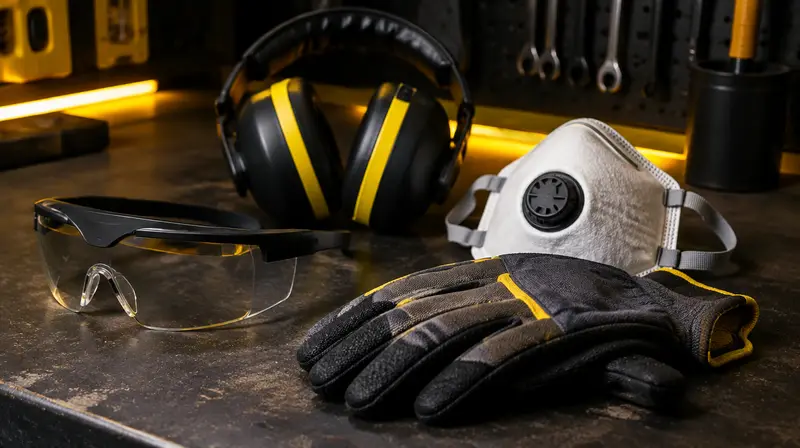
Every power tool has its own way of hurting you. A drill can wrap a sleeve, a grinder can shatter a disc, a circular saw can kick back towards you. The good news is that most accidents follow a few predictable patterns, and a handful of habits prevent nearly all of them. This guide covers general rules first, then tool-specific hazards.
The golden rules
- Read the manual. Seriously.
- Protect eyes, ears and lungs.
- Clamp the workpiece; keep both hands on the tool when it has two handles.
- Unplug the tool or remove the battery before changing bits, blades or discs.
- Never remove guards, and never force a tool.
- Stay out of the line of kickback.
General rules for all power tools
Your workspace
- Good lighting and a clear, dry floor. Clutter causes trips at the worst moment.
- Stable work surface: sawhorses, a workbench or a folding work table. Never cut on your knee.
- Keep children and pets out of the room.
- Good ventilation for dust and fumes. Do not use tools that spark near flammable liquids or gas.
Yourself
- Wear protective equipment suited to the task.
- No loose sleeves, dangling cords, jewellery or untied long hair.
- Do not use tools when tired, rushed, or after drinking alcohol or taking medication that affects alertness.
- Keep a firm stance and do not overreach, especially on a ladder.
The tool
- Inspect cords, plugs, guards and batteries before use. Retire damaged batteries.
- Use the right accessory for the material and make sure its maximum speed rating is at least the tool's speed.
- Remove adjusting keys and wrenches before switching on.
- Check the switch is off before inserting a battery or plugging in.
- For corded tools outdoors or in damp areas, use a GFCI / RCD protected outlet.
Drills and drill-drivers
- Hazard: wrist twist. When a large bit jams, the drill body spins. Use the side handle, low gear and a firm grip. Many modern drills have anti-kickback electronics, but do not rely on them.
- Hazard: entanglement. Loose gloves, sleeves and hair can wrap around the chuck.
- Hazard: hidden wires and pipes. Scan before drilling.
- Hold small workpieces in a clamp or vice, never by hand.
Impact drivers and impact wrenches
- Use only impact-rated bits and sockets; standard chrome sockets can shatter.
- They are loud: wear hearing protection for extended use.
- Do not use them for final torque on wheel nuts; use a torque wrench.
Rotary hammers
- Always use the side handle; a jammed bit in a rotary hammer can wrench your arms.
- Use goggles when drilling overhead and a mask for silica dust.
- Take regular breaks to limit vibration exposure.
Angle grinders
The angle grinder is one of the most dangerous handheld tools. Read our full angle grinder guide before first use.
- Never remove the guard. Position it between the disc and you.
- Use the side handle and both hands.
- Check the disc for cracks and that its rated RPM is at least the grinder's speed. Never fit a larger disc or a saw blade not approved for grinders.
- Let the grinder reach full speed before touching the work; stand to the side, out of the disc's plane, when starting.
- Use the right disc: cutting discs are for cutting (edge), grinding discs for grinding (face). Never grind with the face of a thin cutting disc.
- Watch for sparks: remove flammables from the area.
Circular saws and mitre saws
- Kickback happens when the blade pinches in the cut and the saw jumps back towards you. Support the board on both sides so the cut opens as you saw, and stand to one side of the blade line.
- Set the blade depth to about 5–6 mm (1/4 in) below the material.
- Never tie back or wedge the lower guard.
- On a mitre saw, keep hands at least 15 cm (6 in) from the blade and wait for it to stop before lifting.
Jigsaws and reciprocating saws
- Check what is behind or below the cut; jigsaw blades extend below the material.
- Hold the shoe firmly on the workpiece to avoid chattering.
- Let the blade stop before lifting it out of the cut.
Sanders and multi-tools
- Dust is the main hazard. Use extraction and a respirator.
- Do not sand old paint without testing for lead.
- Keep fingers away from the blade of a multi-tool; it cuts skin easily.
Routers
- Feed direction matters: move the router against the rotation of the bit to avoid it running away.
- Take shallow passes; never full depth in one go.
- Ensure the bit is inserted to the correct depth in the collet and tightened.
Heat guns
- Nozzles reach several hundred degrees and stay hot after switching off. Stand it on its base to cool.
- Never use near flammable materials or to strip lead paint without precautions; it releases lead fumes.
- Do not point at people or use as a hair dryer.
Battery and charger safety
- Use only the manufacturer's charger and genuine or reputable batteries.
- Do not charge damaged, swollen or wet batteries.
- Charge on a non-flammable surface, away from heat, and not unattended overnight if you can avoid it.
- See our battery care guide.
Frequently asked questions
What is kickback?
A sudden, violent reaction when a blade, disc or bit binds in the material. The tool jumps towards the operator or twists. Correct support, sharp blades, guards and correct stance prevent most kickback.
Which power tool causes the most injuries?
Table saws, circular saws and angle grinders are responsible for many serious DIY injuries. Treat them with extra respect and never remove their guards.
This guide is general information, not professional advice. Always read your tool's manual, use the right protective equipment and follow local building and electrical codes. See our disclaimer.