Beginners: Start Here
Hand Tools or Power Tools? When a Screwdriver Is Enough
When a simple hand tool does the job better, and when a drill, driver or saw really pays for itself. A practical guide for first-time buyers.
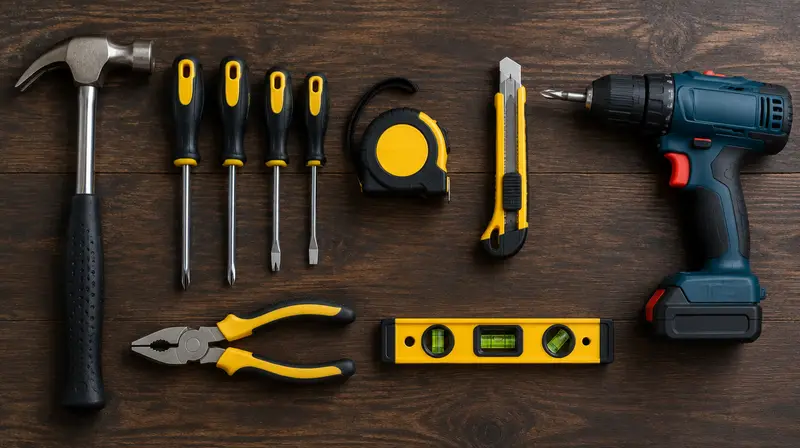
A cordless drill is one of the most satisfying purchases a new DIYer can make, but it does not replace hand tools. Some jobs are faster, safer and neater by hand. Others are practically impossible without power. Knowing the difference saves money and prevents damage to screws, furniture and walls.
Quick answer
- Hand tools win for a few screws, delicate materials, small or brittle fixings, tight spaces and final tightening.
- Power tools win for drilling holes (especially in masonry), driving many or long screws, cutting boards and sheet material, sanding and mixing.
- Rule of thumb: if a job needs more than ~10 screws, a hole in a wall or a straight cut longer than 30 cm, a power tool pays off.
When a hand tool is the better choice
Small numbers of screws
Tightening a loose door handle or a cupboard hinge takes seconds with a screwdriver. Fetching, fitting a bit and adjusting the clutch on a drill takes longer than the job itself.
Flat-pack furniture with soft materials
Chipboard and MDF furniture is easy to strip. A drill-driver can be used to get screws most of the way in on a low clutch setting, but final tightening, especially of cam locks and small screws into chipboard, is best done by hand so you feel when it is snug. Our flat-pack furniture guide shows the technique.
Delicate and small fixings
Electronics, eyeglasses, switch plates, brass screws and small hinges need the control of a hand screwdriver. Over-torque from a power tool can snap a brass screw or crack plastic instantly.
Tight spaces
A stubby screwdriver or a ratcheting driver fits where a drill body cannot, such as behind a sink or inside a cabinet.
When a power tool pays for itself
Drilling holes
Drilling by hand with a brace or hand drill is possible in wood but painfully slow. In brick or concrete it is not realistic. Any job involving wall plugs in masonry needs at least a hammer drill; for concrete a rotary hammer is the right tool.
Driving lots of screws or long screws
Decking, stud walls, plasterboard, building a workbench or assembling large wardrobes all involve dozens or hundreds of screws. A drill-driver or impact driver saves time and your wrist.
Cutting
A handsaw is fine for a few cuts in timber. For sheet materials, curves, laminate flooring or many straight cuts, a jigsaw or circular saw is faster and more accurate.
Sanding, mixing and grinding
Hand sanding a door is a day's work; an orbital sander does it in an hour. Mixing tile adhesive or plaster by hand gives lumpy results; a paddle mixer gives a smooth mix in a minute.
Side-by-side comparison
| Job | Hand tool | Power tool | Best choice |
|---|---|---|---|
| Tighten a loose hinge | Screwdriver | Drill-driver | Hand |
| Assemble a wardrobe | Screwdriver, hex key | Drill-driver (low clutch) | Both: power to start, hand to finish |
| Hang a shelf on a concrete wall | Not practical | Hammer drill / rotary hammer | Power |
| Cut a shelf to length | Handsaw | Jigsaw / circular saw | Either; power for many cuts |
| Change a phone battery | Precision screwdriver | Not suitable | Hand |
| Build a deck | Not practical | Impact driver, circular saw | Power |
| Loosen wheel nuts | Lug wrench / breaker bar | Impact wrench | Either; hand is fine for occasional use |
Electric screwdrivers: the middle ground
Small electric screwdrivers (usually 3.6V to 7.2V with a built-in battery) are popular for furniture assembly. They are light and gentle, and some have an adjustable torque setting. They cannot drill masonry and are no substitute for a proper drill-driver, but if you only assemble furniture and hang the odd picture on a plasterboard wall, one can be enough.
A drill-driver with the right clutch setting does the same job as an electric screwdriver and can drill holes too. If your budget allows only one tool, choose the drill-driver.
Our recommendation for beginners
- Buy a good set of hand tools first (see our basic home tool kit).
- Add a cordless 18V/20V drill-driver with two batteries.
- Add other power tools only when a real project needs them, and consider renting for one-off jobs.
Frequently asked questions
Can I assemble IKEA furniture with a drill?
Yes, on the lowest clutch setting and slow speed, but finish by hand. Chipboard strips easily, and cam locks should never be driven with a power tool.
Is an electric screwdriver worth it?
For light furniture assembly, yes. For anything involving holes in walls, buy a drill-driver instead.
Will a power tool damage screws?
It can if the clutch is set too high or the bit is worn or the wrong size. Use the correct bit, press firmly and start on a low clutch number.
This guide is general information, not professional advice. Always read your tool's manual, use the right protective equipment and follow local building and electrical codes. See our disclaimer.